
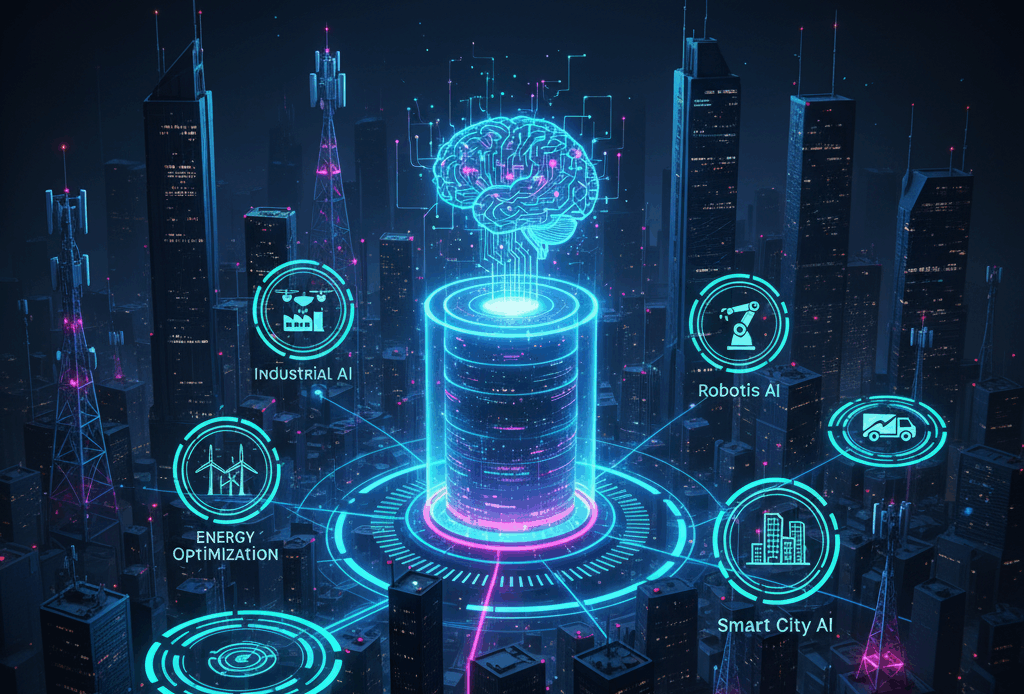
Picture a cell tower that doesn’t just transmit – it anticipates and computes. This isn’t science fiction – it’s the direction set in Washington, D.C., where Jensen Huang, NVIDIA’s co-founder and CEO, used his October 2025 GTC keynote to argue that telecom is “critical national infrastructure.” He then unveiled a telecom-grade platform aimed at putting AI inside the radio access network (RAN), framing it as the next great leap in accelerated computing. NVIDIA backed the thesis with a $1 billion equity investment in Nokia – a move that turns a talking point into a concrete product roadmap.
This looks like a telco headline. It isn’t. It’s an overdue convergence of the world’s two most critical infrastructures: edge compute (where AI resides) and connectivity (where the world’s data flows). If AI is the brain of the digital economy, the network is its nervous system. The next step is obvious: make the nervous system learn, turning a connectivity pipe into a ubiquitous computing utility.
The Shift: From “AI around the network” to “AI into the Network”
“The next leap in telecom isn’t just from 5G to 6G – it’s a fundamental redesign of the network to deliver AI-native connectivity.” This is the core thesis of the platform shift articulated by Nokia and its partners.
Operators already use AI to route traffic, predict failures, optimize energy usage, and prioritize support. But that’s “AI around the network.”
The shift to bringing “AI into the radio access network” -encompassing baseband signal processing, scheduler decisions, and on-site inference – has been an active pursuit by multiple vendors. This move was clearly signaled at MWC Barcelona in March 2025, where vendors like Samsung showcased advances in unifying AI and mobile network capabilities with NVIDIA.
The recent NVIDIA platform push, cemented by its strategic partnerships with Nokia, is about commercially hardening and scaling this vision. NVIDIA’s new Aerial RAN Computer (ARC) is designed to co-locate RAN workloads and AI inference on accelerated nodes.
The difference is more than semantic. External AI tunes a network; internal AI enables it to learn, predicting interference, shaping beams in real-time, and even hosting enterprise application inferencing at the cell site. This foundational convergence unlocks two compounding flywheels: a self-optimizing network for the operator and a real-time compute utility for the enterprise.
Why This is a $200 Billion Mandate for All Stakeholders
The business case for AI-RAN is a dramatic transformation of the existing network cost structure into a new, monetizable compute grid. The total global AI-RAN market opportunity is projected to exceed a cumulative $200 billion by 2030 (Source: Omdia), an opportunity driven by shared TCO benefits and new service creation.
For Telcos & Managed Service Providers (MSPs): The Financial Inflection Point
For years, operators have built extraordinary networks, while most of the value has been pooled in over-the-top platforms. AI-RAN as an edge data center flips the script.
- New Revenues: The GPUaaS Opportunity. By selling the newly available compute cycles at the network edge, Telcos & MSPs gain an entirely new revenue stream. This GPU-as-a-Service (GPUaaS) opportunity is projected to generate over $21 billion for the telecom industry by 2030 (Source: ABI Research), primarily through hosting low-latency inference workloads for external enterprise customers.
- New Revenues: The Edge AI Inferencing as a Service. Telcos and MSPs can sell intelligent connectivity—latency-aware SLAs and packaged edge inference (vision AI for retail, industrial quality control, and safety analytics)—delivered from either a public or private RAN footprint. This transforms the business model from selling bits to selling AI-enabled insights.
- A Better Cost Curve: The TCO Advantage. The consolidation of purpose-built accelerators into shared ARC/GPU nodes enables operators to significantly improve resource utilization—from typical single-digit usage to nearly 100% by dynamically running RAN and AI workloads concurrently. Initial industry models project running this dual workload on shared infrastructure can deliver up to 30-40% TCO savings over three years compared to traditional RAN infrastructure.
And this isn’t vaporware. Multiple major RAN vendors (Nokia, Samsung, Ericsson, and others) are committing to a full GPU play for AI-RAN, and T-Mobile US is named for 2026 field trials. That’s a concrete milestone operators and investors can track.
For Enterprise & System Integrators: The Gateway to Application Innovation
The true revolution in this model lies not in network optimization, but in unlocking a new industrial edge.
- Proximity = performance. Most useful data never reaches a distant cloud – factory vision streams, vehicle telemetry, logistics scanners. Running AI near radios reduces latency and provides context that the cloud can’t see, including RF conditions, congestion, mobility, and local policy. That context is what turns predictions into practical actions.
- Faster learning loops for mission-critical operations. AI models embedded in the RAN observe live behavior and adapt in deployment, not just in pre-training. When policies for scheduling or beamforming improve hour by hour, the network’s performance curve bends during operations, directly translating to more reliable and efficient enterprise services, such as private 5G.
- Expediting Cellular Adoption by Enterprise. For factories and campuses, AI-RAN transforms the private and even public cellular network from a simple connectivity layer into a fully integrated compute platform. This unification drastically reduces the complexity and CapEx of building separate, parallel IT and telecom stacks, making the business case for private 5G/6G compelling overnight.
The Broader Context: A Compute Platform, Not Just a RAN Solution
This push toward the intelligent edge validates NVIDIA’s core strategic move to embed its accelerated computing platform across the entire global infrastructure.
Immediately following the Nokia news, Samsung and NVIDIA announced an expanded partnership focused on building a next-generation AI Megafactory for chip production, emphasizing the critical link between edge compute and industrial operations. By deploying more than 50,000 NVIDIA GPUs, AI will be embedded throughout Samsung’s entire manufacturing flow, accelerating development and production of next-generation semiconductors, mobile devices, and robotics.
While not a direct AI-RAN announcement, this initiative highlights NVIDIA’s strategy to make its accelerated computing and AI frameworks—like CUDA and Omniverse—the universal operating system for physical-world intelligence. This shared architectural vision with major global technology players, such as Samsung, validates the thesis that every component of infrastructure, from chip manufacturing floors to remote cell sites, is becoming an AI compute factory. This ultimately empowers enterprises to deploy AI reliably, regardless of the hardware partner they choose.
The Final Paradigm Shift: Wireless is Becoming a Programmable Intelligent Compute Platform
Huang’s line from D.C. sticks: “We’re moving from connecting machines to coordinating intelligence.” In practice, this translates to base stations hosting small language models for local tasks, predicting device mobility to pre-allocate resources, and steering spectrum allocation with learned policies instead of static rules. The trajectory is clear: the wireless access network becomes a compute device, and the entire telecom infrastructure (public or private) is recast as a programmable, intelligent computing platform ready to host the next generation of industrial AI.
The Objections—and Why They Don’t Change the Conclusion
- “GPUs are expensive.” True – and the wrong baseline. The question isn’t chip price; it’s TCO per outcome when RAN and AI inference share acceleration, when energy/bit consumption falls thanks to ML scheduling, and when time-to-feature is reduced. If pilots show those curves bending, the economics follow.
- “This sounds complex.” Platform shifts always are. The practical path involves brownfield overlays in dense urban macro areas with one or two enterprise SKUs (e.g., computer vision) and clear success metrics before scaling. Private Cellular (5G & later 6G) is a greenfield opportunity to be tapped immediately.
- “Isn’t this vendor lock-in?” CUDA’s gravity is real, but so is the benefit of a mature AI stack that actually works at telecom reliability. The mitigation is architectural: insist on O-RAN interfaces and published KPIs. Industry approaches argue in favor of openness as a competitive necessity.
Call to Action
The convergence of AI and the RAN is not a technical footnote—it is the single greatest opportunity this decade for enterprises, telcos, and MSPs to unlock productivity and monetization.
Your company must define its strategy now: Build the new utility, Buy services from it, or Be Displaced by competitors who master this connected AI edge.
If you would like to share your thoughts on this topic on my podcast, or speak and showcase your private 5G and Edge AI solution at our upcoming Connected Edge AI summit, please email me or message me on LinkedIn.