
Quick Answer:
AI search visibility is how often your brand appears in the answers generated by AI tools like ChatGPT, Perplexity, and Google AI Overviews when a buyer asks a question relevant to your solution. For B2B tech and telecom vendors, this is no longer a future concern. Forrester’s research shows that 89% of B2B buyers now use generative AI during their buying process, and a 2026 study by B2B go-to-market research firm 2X found that 95.7% of companies are absent from the AI-generated answers shaping early-stage vendor shortlists. If your brand is not showing up in those answers, you are not losing traffic. You are losing the conversation entirely.
According to Forrester’s Buyers’ Journey Survey, 89% of B2B buyers reported using generative AI as one of their primary research sources across every stage of the purchase process.
That number is not a forecast. It is the current reality of how your buyers are gathering information, forming opinions, and building vendor shortlists before anyone on your team knows they exist.
The behavior shift is straightforward. When a technology director or CTO needs to understand a solution category, compare vendors, or validate a shortlist, they are not opening Google and scrolling through ten blue links. They are typing a question into ChatGPT, Perplexity, or Google AI Overviews and reading a synthesized answer in under sixty seconds. If your brand is not in that answer, you are not just harder to find than your competitors. You are invisible to that buyer at the exact moment their opinion is forming.
This is not a traffic problem. It is a revenue problem. Deals are influenced in AI answers, long before the demo request, long before the proposal. The following practical steps will show you how to change that, and how KAIROS Pulse’s AEO and GEO services are designed to help B2B tech and telecom vendors do exactly that.
The Three Layers of AI Search (And Where Most B2B Brands Are Getting Stuck)
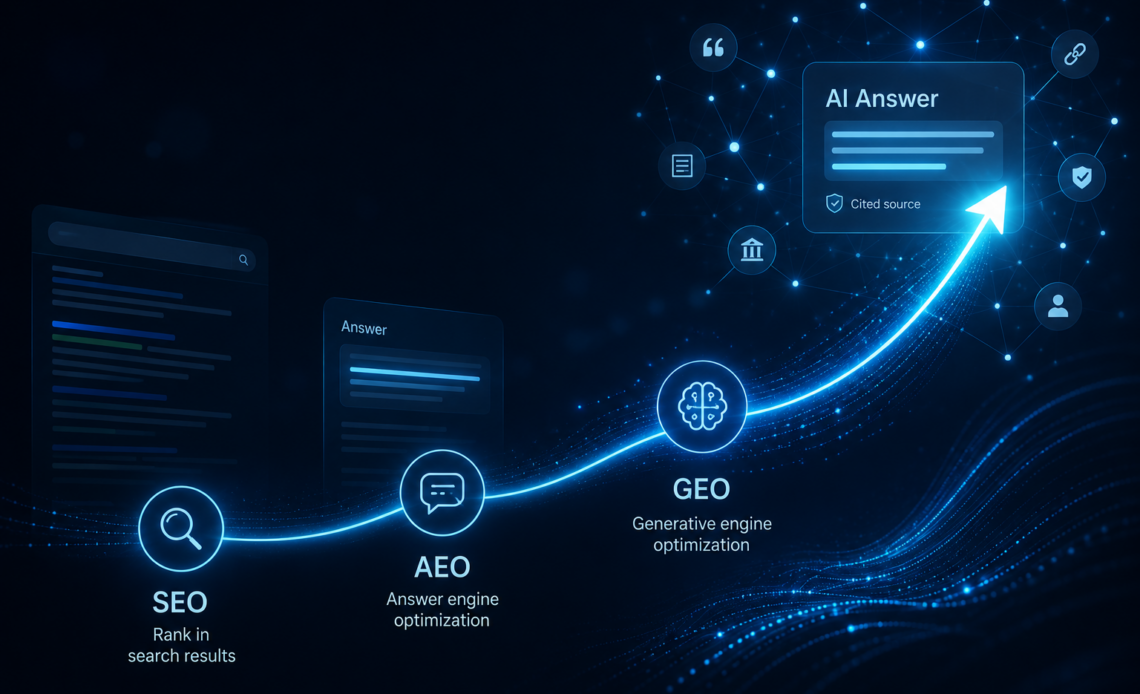
Modern AI search does not work in a single layer. It works in three, and most B2B tech and telecom vendors are only playing in one of them.
The Three Layers
Not all AI search visibility is the same. Each layer operates differently, rewards different content behaviors, and reaches your buyer at a different stage of their research. Here is how they break down.
SEO (Search Engine Optimization)
Getting your pages to rank in traditional organic search results. This is where the vast majority of B2B marketing budgets are focused, and it still matters. But on its own, it is no longer enough.
AEO (Answer Engine Optimization)
Structuring your content so AI systems can extract a clean, direct answer from it and surface it as a zero-click response or featured snippet. The buyer gets their answer without ever visiting your site.
GEO (Generative Engine Optimization)
Earning your place as a cited, trusted source inside AI-generated answers on platforms like ChatGPT, Perplexity, and Google AI Overviews. This is where vendor shortlists are being built in 2026.
Where the Gap Is
Most B2B brands are investing almost exclusively in layer one. The problem is that your buyers have moved to layers two and three. IT directors, CTOs, and technology innovation leaders are using AI tools to research solution categories, compare vendors, and pre-rank their shortlists before they ever contact a sales team. By the time your SDR reaches out, the decision is already leaning somewhere. Closing that gap is precisely what KAIROS Pulse’s AEO and GEO services are built for.
PRO TIP: Write for Questions, Not Just Keywords
Winning layers two and three of AI search requires a different kind of content. The practical steps below are the highest-leverage moves a B2B tech or telecom vendor can make right now to improve how AI systems find, read, and cite their content.
| What to Do | Why It Works |
| Structure content around buyer questions | AI systems are trained to match questions to answers, not keywords to pages |
| Place a clear 2–3 sentence answer near the top of each piece | Makes it easy for AI to extract and cite your response directly |
| Use plain, specific language over marketing generalities | Specificity signals authority to AI systems |
| Ground examples in your buyer’s real context | Contextual relevance increases citation likelihood |
Write for the Question Your Buyer Is Actually Asking
AI search systems are not scanning your content for keywords. They are scanning it for answers. That means every major topic you cover should include a clearly stated question and a concise, direct response within the first few lines of that section.
For a private 5G vendor selling to enterprise customers, that might look like this: “What does a private 5G network actually deliver for a port operations company?” followed immediately by a two to three sentence answer that speaks to uptime, operational control, and latency, in plain language. Not a brochure. An answer.
Specificity Is What Gets You Cited
Generic content does not get quoted by AI systems. Specific, authoritative, contextually grounded content does. The brands that show up in AI answers are the ones that have committed to depth over breadth, and to answering real buyer questions rather than optimizing for search volume alone.
If you are unsure whether your current content is structured to perform in AI search, KAIROS Pulse’s dedicated AEO and GEO services examine exactly this: where your content sits across all three layers, what signals are missing, and what it would take to close the gap.
Topical Authority Is What AI Systems Actually Reward
Publishing one strong article on a topic does not make your brand an authority in the eyes of an AI system. It makes you a participant. Authority is built differently, and the brands earning consistent citations in AI-generated answers have figured out how.
What Topical Authority Actually Looks Like
AI systems assess authority by looking at the depth and consistency of your content across a topic, not the quality of a single piece. A cluster of eight to ten interconnected, high-quality articles all pointing back to a central pillar page signals something a single post never can: that you own this space.
The content cluster approach works because it demonstrates:
- Sustained commitment to a topic over time
- Coverage of the topic from multiple angles and buyer perspectives
- Internal linking that reinforces the relationships between ideas
- A clear, crawlable content structure that AI systems can map and reference
What This Means for Telecom and B2B Tech Vendors
If you sell private 5G networks to enterprise customers, one blog post that mentions private 5G is not enough. Your content needs to surround the conversation your buyer is having. That means articles covering:
- What private 5G delivers versus public network alternatives
- How to build the business case for private 5G internally
- What enterprise procurement teams need to know before evaluating vendors
- How private 5G integrates with existing operational technology
- The real total cost of ownership over a five-year deployment
If you are not sure where the gaps in your content cluster are, start by understanding why sales and marketing teams become misaligned, as it is often the root cause of uneven topical coverage.
Building that depth is a core part of what KAIROS Pulse delivers as an extended product marketing team, with content strategy structured from the ground up for AEO and GEO performance.
Third-Party Citations Are Now a GEO Signal, Not Just a PR Win
Most B2B tech and telecom vendors think of guest posts, podcast appearances, and analyst mentions as brand awareness activities. In 2026, they are something more concrete than that. They are the signals AI systems use to decide whose voice is worth quoting.
Why Third-Party Mentions Matter More Than Ever
AI systems do not just read your website. Research from McKinsey found that a brand’s own website accounts for only five to ten percent of the sources AI search platforms reference. The other ninety percent comes from publishers, industry media, user-generated content, and review platforms. That means the content you do not control is doing most of the work of establishing whether AI systems treat you as an authority or ignore you entirely.
What Counts as a GEO Signal
Not all third-party mentions carry equal weight. The signals that move the needle are those that appear on sources AI systems already treat as credible. For telecom and B2B tech vendors, that includes:
- Bylined articles in trade publications such as RCR Wireless and PrivateLTEand5G
- Expert quotes cited in industry research reports
- Podcast appearances on recognized B2B tech shows like ALYNMENT
- Mentions or rankings in analyst reports from firms like Gartner, IDC, or Forrester
- Case studies published by technology partners or platform vendors
- Reviews and ratings on B2B platforms such as G2 or Gartner Peer Insights
For a grounding in how AI in telecom is reshaping the landscape your buyers are researching, this is a strong starting point.
Treating PR as a GEO Strategy
The practical shift here is in how you brief and prioritize your external content activity. Every placement is not just reach. It is a citation signal telling AI systems that credible sources in your industry consider you worth referencing.
LinkedIn is worth treating with the same intent. Consistent, expert-led content from named individuals, particularly founders and subject matter experts, builds the brand association signals that AI systems increasingly factor into authority decisions.
The same logic applies internally, credible, well-structured content that demonstrates sales and marketing alignment for B2B tech is more likely to earn third-party references that build your GEO authority.
| Activity | GEO Signal Value |
| Bylined article in trade publication | High: authoritative domain, indexed, crawlable |
| Analyst report mention | High: Gartner, IDC, Forrester carry strong AI trust signals |
| Podcast appearance with show notes | Medium to High: especially if the show has strong domain authority |
| B2B review platform listing | Medium: G2, Gartner Peer Insights are frequently cited by AI systems |
| LinkedIn presence and content | Low to Medium: consistent LinkedIn activity from named experts increases brand association and can contribute to AEO and GEO signals when content is indexed |
You Cannot Win a Game You Are Not Tracking
Most B2B tech and telecom vendors have no idea whether they appear in AI-generated answers when their buyers ask buying questions. That is not a minor gap in reporting. It is a structural blind spot at the top of the revenue funnel.
The Scale of the Problem
According to Exposure Ninja, only 22% of marketers are actively tracking AI visibility and traffic. That means the overwhelming majority of B2B brands are making content and marketing investment decisions with no visibility into the channel where their buyers are increasingly forming their vendor shortlists.
A Simple Monthly Test You Can Run Right Now
You do not need an enterprise tool to start. Begin with this:
- Write down the top five questions your buyers ask before they ever contact your sales team
- Type each question into ChatGPT, Perplexity, and Google AI Overviews separately
- Note which brands appear in the answers
- Note whether your brand appears, and if so, how it is described
- Record your findings month over month and watch for movement
That gap between where you appear and where your competitors appear is your GEO competitive intelligence. It tells you exactly which topics you need to build authority around and which AI platforms are not yet picking up your brand.
Tools to Support Ongoing Tracking
Once the manual test has given you a baseline, structured tracking tools make the process scalable. If you would rather have a specialist run this for you, KAIROS Pulse offers ongoing AEO and GEO tracking as part of its extended product marketing services, so you have a clear, consistent picture of where your brand stands in AI search without adding it to your internal workload.
For context on how AI is already reshaping internal alignment, see how conversational AI can help align sales and marketing.
The Window Is Still Open. But It Will Not Stay That Way.
The B2B tech and telecom vendors who invest in AI search visibility today will be the ones AI systems recommend tomorrow. Most companies in this space have spent years building content, developing thought leadership, and earning credibility in their market. That foundation does not need to be replaced. It needs to be restructured, amplified, and optimized for a world where AI does the first layer of research that used to belong to your buyers. The early movers will own the category. The question is whether you are one of them.
Wondering where your brand stands in AI search right now? Book a free AI Visibility Snapshot with the KAIROS Pulse team and find out exactly where your content sits across all three layers of AI search, and what KAIROS Pulse’s AEO and GEO services can do to move the needle. Visit kairospulse.com/contact to get started.
Frequently Asked Questions
What is AI search visibility for B2B companies?
AI search visibility refers to how frequently and prominently your brand appears in the answers generated by AI tools such as ChatGPT, Perplexity, and Google AI Overviews when a buyer asks a question relevant to your solution category. For B2B tech and telecom vendors, it measures whether your brand, your point of view, and your expertise are being surfaced at the moment a buyer is forming their opinion about which vendors are worth talking to.
What is the difference between SEO, AEO, and GEO?
SEO (Search Engine Optimization) focuses on getting your pages to rank in traditional organic search results and drive clicks to your website. AEO (Answer Engine Optimization) focuses on structuring your content so AI systems can extract a clean, direct answer from it and surface it as a zero-click response or featured snippet. GEO (Generative Engine Optimization) focuses on earning your brand a place as a cited, trusted source inside the synthesized answers generated by AI platforms like ChatGPT and Perplexity. All three layers matter, but most B2B brands are currently only investing in the first.
How do I get my brand cited in ChatGPT or Perplexity?
There is no single switch to flip, but there are consistent behaviors that increase citation likelihood. Structure your content around the specific questions your buyers ask, and provide clear, concise answers near the top of each piece. Build topical authority through clusters of interconnected, high-quality content rather than isolated articles. Earn third-party citations from credible industry publications, analyst reports, and trade media. And ensure your content is technically accessible and well-structured so AI systems can read and index it cleanly.
How do I know if my content is showing up in AI search results?
Start with a manual test. Identify the top five questions your buyers ask before contacting your sales team and type each one into ChatGPT, Perplexity, and Google AI Overviews. Note which brands appear and whether yours is among them. For ongoing tracking, tools such as LLMrefs allow you to monitor brand mentions and citation patterns across AI platforms over time, giving you a measurable baseline to work from and improve against.
Why is my B2B content not showing up in AI search?
The most common reasons are a lack of topical authority, content that is structured for keywords rather than questions, and an absence of third-party citations from sources AI systems treat as credible. A single blog post on a topic is rarely enough to earn consistent AI citations. AI systems reward brands that demonstrate sustained depth across a topic, are referenced by authoritative external sources, and produce content that directly answers the questions buyers are asking. If your content was built primarily for traditional search, it likely needs to be restructured and amplified to perform in AI search.