

Picture this: your phone suddenly drops to one bar during an important video call with your biggest client, and instead of spending 30 minutes on hold with customer service, you get instant help from an AI assistant that checks your local tower status, identifies the issue, and either fixes it remotely or schedules a technician – all within two minutes.
The numbers tell a story that’s hard to ignore. Telecommunications holds the lowest Net Promoter Score at just 31, while other industries manage to hit 38 on average. Nearly 40% of wireless customers walk away because of poor service experiences. Per an Nvidia survey, “enhancing customer experiences remains the biggest AI opportunity for the telecom industry,” and the results are starting to show in everything from consumer mobile support to enterprise wireless solutions.
Nearly 40% of wireless customers walk away because of poor service experiences.
“5 Top Customer Service KPIs for Telecom Companies”, Kayako
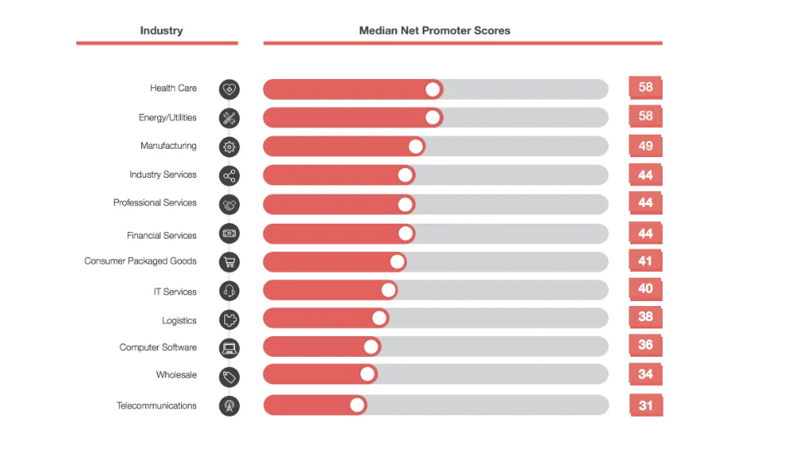

Source: ” Telecom NPS Benchmarks and CX Trends in 2025 | NPS in Telecoms”, Experience Benchmarks
The Problem Is Bigger Than You Think
The wireless industry consistently ranks at the bottom in terms of customer satisfaction. Call centers see turnover rates between 30-45% annually, with some wireless operations over 50%. New agents need months to understand the technical complexity of modern cellular networks, 5G deployment variations, and enterprise wireless solutions – but many don’t stay long enough to reach that level of expertise.
The first-call resolution numbers are brutal. While top-performing call centers achieve 70-79% FCR rates, wireless telecommunications average just 52%. That means nearly half of all customer issues – whether a consumer complaint about slow 5G speeds or an enterprise client dealing with network connectivity problems – require multiple calls and mounting frustration.
The Technical Maze Gets Deeper
Wireless customer service agents today troubleshoot issues across technology that spans generations. A single call might involve 3G legacy systems in rural areas, 4G LTE networks handling bulk traffic, 5G Ultra-Wideband in urban centers, and Wi-Fi calling integration.
For consumers, service plans have evolved into mathematical puzzles. Unlimited data that throttles after 50GB, family plans with individual device financing, streaming bundles, international roaming packages, and 5G access tiers. For enterprise clients, it’s even more complex: private network slices, edge computing integration, IoT device management, and SLA guarantees across multiple service types.
The financial reality is stark. Replacing a single call center agent costs between $10,000 and $20,000, while acquiring new customers costs five times more than keeping existing ones – and enterprise clients often represent millions in annual revenue that can walk away after a single bad support experience.
The Speed of Expectation
Customer expectations have moved faster than most wireless companies can adapt. Customers expect email responses within minutes, but the telecom industry average exceeds 12 hours, which feels like an eternity when your mobile service is down and you’re trying to run a business from your phone.
82% of consumers would rather use a chatbot than wait for a human representative, while 61% of call center leaders report higher volumes since 2020-2021, as remote work made reliable wireless connectivity essential.
How AI Changes Everything
Artificial intelligence isn’t just automating the same old processes – it’s completely rethinking how wireless customer service can work. The difference between traditional chatbots and modern AI is like comparing a flip phone to a smartphone.
Today’s AI systems understand context in ways that feel almost magical. They remember what you said five minutes ago, know when you’re frustrated about slow data speeds, and can switch between technical explanations for IT professionals and simple language for everyday consumers.
More importantly, AI chatbots can handle up to 80% of routine inquiries – from plan changes and billing questions to basic network troubleshooting and device configuration. Smart escalation means customers get transferred to specialized agents with full context and complete interaction history.
AI chatbots can handle up to 80% of routine inquiries.
“Key Statistics on AI in Customer Service: Here’s What the Numbers Reveal”, Plivo
Preventing Problems Before They Happen
Instead of waiting for customers to call about network outages or service disruptions, AI systems can predict these issues and reach out first. They can identify when a cell tower is experiencing problems before consumers notice dropped calls, or when an enterprise client’s private network slice is approaching capacity limits.
AI-powered proactive support reduces repeat inquiries by 25%. Companies using AI report 37% faster first response times, while customer service teams using AI cut call handling time by 45%. These aren’t marginal gains for wireless customers dealing with urgent connectivity issues – they’re transformative improvements.
What’s Actually Happening Right Now
Real companies are deploying real solutions that handle millions of customer interactions across both consumer and enterprise markets.
Verizon has deployed Google Cloud’s Gemini models across 28,000 customer care representatives through its Personal Research Assistant, achieving 96% accuracy while predicting customer call intent with 80% precision. The company’s new Customer Champion system automatically routes callers to specialized agents, while its My Verizon app uses natural language processing to answer personalized billing questions like “Why did my phone bill go up?”
T-Mobile is investing $100 million in its revolutionary IntentCX platform with OpenAI, launching in 2025 as the industry’s first intent-driven AI system that proactively takes actions on customers’ behalf. The platform analyzes billions of interaction data points in real-time and connects directly to transaction systems for autonomous problem resolution across multiple languages.
AT&T’s “Ask AT&T” generative AI tool empowers employees across operations while autonomous assistants instantly analyze customer accounts during calls and coordinate with billing systems. The company’s AI-driven fraud protection reduced attacks by 80% using advanced language models, while predictive maintenance optimizes field technician routes, and digital avatars enhance employee training.
52% of contact centers have invested in conversational AI, with another 44% planning adoption. AI-powered chatbots achieve 80-90% resolution rates in leading wireless implementations, while 86% of service leaders using AI report positive impacts on satisfaction scores.
The operational impact is equally impressive. AI reduces customer service costs by 30-50% through automation, improved agent productivity, and fewer multi-call resolutions.
What’s Coming Next
70% of customer experience leaders plan to integrate generative AI within two years, enabling dynamic creation of troubleshooting guides and personalized explanations tailored to each customer’s technical level. 67% of CX leaders believe AI bots can build stronger emotional connections with customers through advanced emotional intelligence capabilities.
By 2027, chatbots are predicted to become the primary customer service channel for 25% of all businesses, with wireless companies likely leading this transition. Self-healing networks powered by AI will automatically detect and resolve service issues while proactively communicating with affected customers.
Augmented reality will enable AI systems to provide visual troubleshooting assistance for device configuration and network optimization. This could mean AR-guided setup of private 5G networks for enterprise clients. Edge computing deployment will bring AI processing closer to customers, enabling ultra-low latency interactions that feel instantaneous.
Why This Matters More Than You Think
Wireless companies can decrease process costs by 80% while dramatically improving customer experiences through intelligent AI implementation. 53% of telecom companies now recognize AI as a competitive advantage.
Customer behavior has shifted permanently toward digital-first expectations. 61% of customers choose faster AI responses over waiting for human agents, while 64% of consumers cite 24/7 availability as chatbots’ most valuable feature – which aligns perfectly with wireless connectivity’s need for round-the-clock support.
The Service Revolution Is Here
The transformation to AI-powered customer service represents the wireless industry’s chance to move from being a traditionally low-satisfaction sector to leading in customer experience excellence. Companies implementing comprehensive AI strategies today aren’t just improving their operations – they’re becoming the carriers people don’t dread calling when something inevitably goes wrong.
The results speak for themselves: better satisfaction, lower costs, and sustainable competitive advantages. For wireless companies, the question isn’t whether to embrace AI-powered customer service anymore. It’s how quickly they can implement these technologies before their competitors do – and before customers get tired of waiting on hold while their phones don’t work.