

Picture this: It’s 8:47 PM in Mumbai during Diwali celebrations. Millions of people simultaneously post festival photos, stream live events, and video call family across the globe. Within minutes, network traffic explodes by 400%. Traditional routing systems, designed decades ago for a simpler world, buckle under the pressure. Users experience dropped calls, failed uploads, and frozen video streams – while network operators watch helplessly as revenue hemorrhages at $11,000 per minute.
This scenario plays out daily across the globe, from New Year’s Eve in Times Square to the World Cup final in Qatar, from Singles’ Day shopping in China to morning commutes in São Paulo. The world’s mobile networks are drowning in an unprecedented tsunami of data traffic, and the old ways of managing it simply don’t work anymore.
But here’s the game-changer: Artificial intelligence (AI) is transforming these chaotic moments from network nightmares into seamlessly managed events. Leading operators implementing AI-powered routing systems are seeing significant improvements, with some achieving 30% reductions in network failures, turning reactive networks into predictive, self-healing infrastructure that anticipates problems before users notice them.
The Global Traffic Tsunami
The numbers are staggering. The Ericsson Mobility Report predicts that mobile data traffic will grow by a factor of 2.3 by 2030, but this growth isn’t evenly distributed. Asia-Pacific leads with explosive smartphone adoption in markets like India and Indonesia. Sub-Saharan Africa is experiencing the fastest mobile money growth globally. Latin America is seeing massive increases in streaming video consumption.
Each region brings unique challenges:
- Asia-Pacific: Dense urban populations create extreme localized congestion, with cities like Tokyo and Singapore processing more data per square kilometer than entire countries elsewhere
- Europe: Aging infrastructure meets sustainability mandates, requiring networks to do more with less energy
- North America: Enterprise and IoT applications demand ultra-low latency across vast geographic distances
- Latin America: Rapid urbanization strains networks as populations migrate from rural to metropolitan areas
- Middle East & Africa: Mobile-first economies bypass traditional infrastructure, placing enormous loads on cellular networks
Traditional routing systems were never designed for this complexity. They operate like traffic lights that never change – rigidly following predetermined rules while traffic patterns shift dynamically around them. The result? Network resources sit underutilized in quiet zones while other areas experience severe congestion, creating billions of dollars in stranded capacity that operators have paid for but cannot effectively deploy.
How AI is Rewriting the Rules
Artificial intelligence transforms network routing from a reactive, rule-based process into a predictive system that can optimize traffic management across an operator’s entire network. Instead of managing individual cell towers in isolation, AI systems can now coordinate routing decisions across vast swaths of an operator’s towers, base stations, and network equipment within their coverage area.
Advanced AI systems deploy reinforcement learning algorithms that simulate millions of traffic scenarios from various regions and events. These systems identify complex patterns invisible to human operators – like how Ramadan affects data usage patterns, how monsoon seasons impact network performance, or how major sporting events influence bandwidth demand within their coverage areas.
Global Success Stories
The transformation is already happening worldwide, with measurable results across every continent:
- Asia-Pacific: Major regional operators are deploying AI systems to handle massive traffic spikes during events like shopping festivals and holidays, when network usage can increase dramatically within hours. Operators across Asia are implementing machine learning algorithms to predict and manage these predictable but intense traffic patterns.
- Europe: Nokia’s AVA Platform, live across multiple European operators, provides real-time network slice optimization for 5G networks, delivering significant improvements in resource utilization through dynamic traffic routing. Ericsson’s Explainable AI substantially reduces troubleshooting time for network engineers through automated root cause analysis and corrective action recommendations.
- North America: Verizon has implemented AI-driven predictive analytics across its fiber-optic backbone, achieving a 30% reduction in network failures. T-Mobile’s real-time optimization platforms cover 99% of Americans, with AI systems analyzing billions of data points to adjust antenna configurations automatically.
- Middle East: Operators like Etisalat are implementing AI systems to manage the unique challenges of serving diverse populations across regions like the UAE, from high-tech urban centers like Dubai to more traditional areas, optimizing network performance across varied usage patterns.
- Africa: Operators across the continent are exploring AI applications to optimize networks for the unique challenges of mobile-first economies, where cellular networks often serve as the primary means of connectivity and digital commerce.
The global statistics are compelling: 97% of telecom companies now use or are testing some form of AI, with 53% believing it provides a competitive advantage – up from 39% in 2022. This isn’t just about technology adoption; it’s about survival in an increasingly connected world.
What’s Coming Next?
The next generation will create fully autonomous networks that self-heal, self-optimize, and adapt without human intervention. Self-healing networks will continue to emerge, automatically detecting equipment failures and instantly rerouting traffic while ordering replacement equipment – all without human involvement.
Predictive capacity planning will mature by 2026-2027, with AI systems analyzing urban development patterns and demographic shifts to automatically trigger network expansion 6-12 months before demand materializes. Zero-touch operations will achieve a reality by 2027-2028, with complete automation significantly reducing operational costs through intelligent network management.
Advanced capabilities will include digital twin networks enabling real-time simulation of routing changes before implementation, and intent-based networking where AI systems understand business objectives and automatically configure networks to achieve specific outcomes like “optimize for gaming performance during evening hours.”
Market transformation will unfold in phases. Mainstream adoption between 2025 and 2026 will see the global market reach $23.9 billion by 2033. Intelligence evolution from 2027 to 2029 will bring generative AI integration advances. Beyond 2030, autonomous infrastructure will feature networks that learn continuously without human oversight.
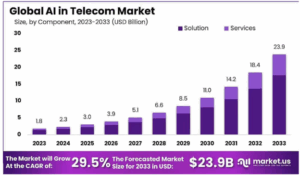
Major technology partnerships drive development, including NVIDIA-ServiceNow alliances for generative AI solutions and Microsoft-Nokia collaboration on cloud-native platforms. Research priorities emphasize energy-efficient algorithms, with Google reporting 30% energy savings using AI in data centers, and edge computing integration bringing AI decision-making closer to users.
The Global Competitive Imperative
The transformation to AI-powered routing represents more than a technological advancement – it’s becoming an operational necessity for survival. Organizations implementing intelligent routing today position themselves at the forefront of telecommunications innovation, delivering superior user experiences while building foundations for autonomous operations. As mobile data demand continues to experience explosive growth, only networks powered by artificial intelligence will have the adaptive capacity to meet user expectations while maintaining operational efficiency.